
A formed element that sets the waterstop position in the construction joint, typically one of the most critical joints in watertight concrete.
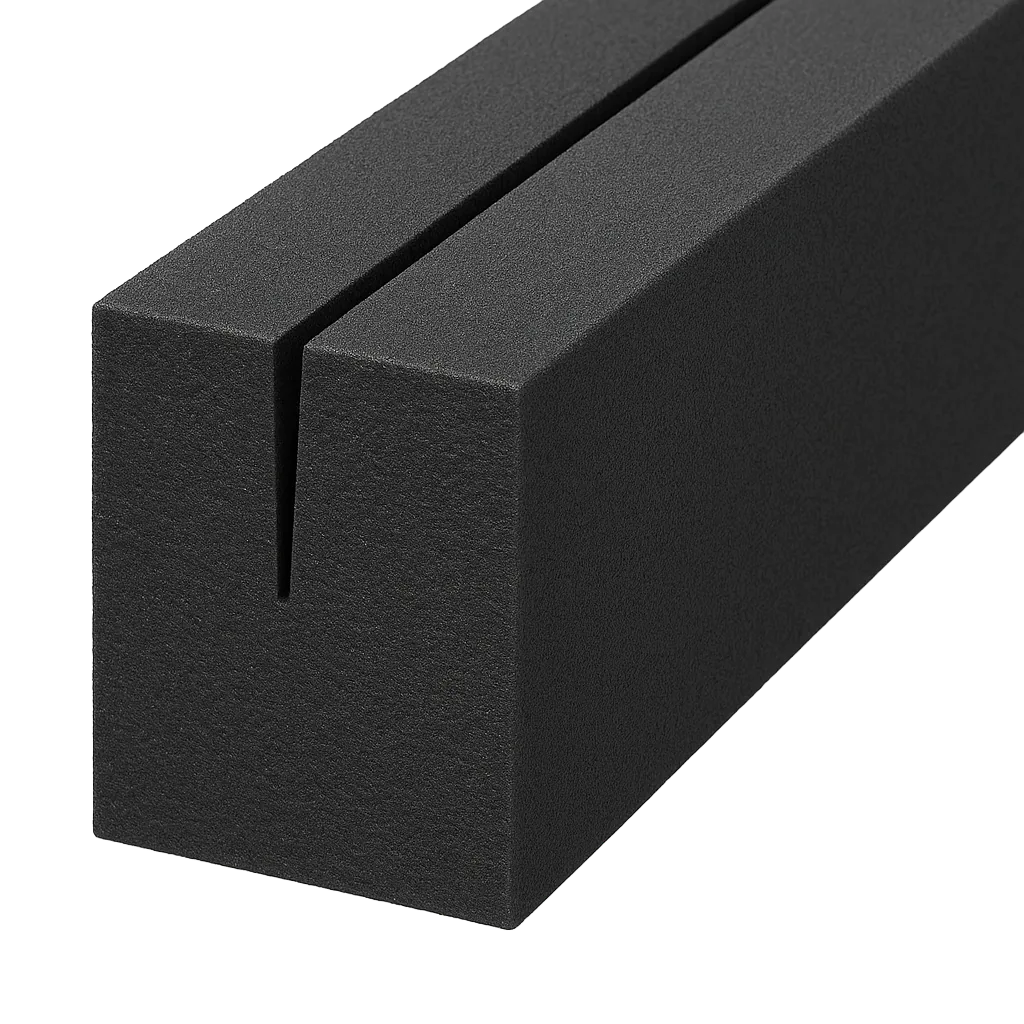
The FBZ waterstop centering element is a patent-pending molded foam part that guides waterstop sheets to the center of construction joints, typically between base slab and rising wall of a watertight concrete structure, but it fits wherever a metal waterstop is cast in. Displacement, insufficient rebar clearance and wrong embedment depth are reduced by design. Installation is done by hand, without special tools.
Leaks often appear in the same places.
From expert-witness experience, leaks in watertight concrete structures often trace back to poorly executed penetrations, joints and connections.
The construction joint between base slab and wall is a recurring weak point of watertight concrete structures.
It arises in almost every watertight structure, where water pressure and groundwater meet the concrete. Errors at the waterstop directly affect water tightness here.
The 5 sources of error at the waterstop
They arise from time pressure, improvisation and positioning that is often done by eye.
- 01 Displacement during the pour
Insufficient fixation, the sheet shifts when concrete is placed.
- 02 Insufficient rebar clearance
Minimum clearance not met, concrete fails to fully encase the sheet.
- 03 Poor centering
The sheet does not sit centered, one-sided embedment.
- 04 Wrong embedment depth
Too little or too much embedment, without a control tool.
- 05 Coating damage
Damage during the pour, water tightness compromised.
One element. Three steps. No special tools.
Position the waterstop and fix it to the reinforcement as usual.
Push the FBZ from above onto the protruding part of the waterstop; the slit guides the sheet to the center.
Place the concrete. The FBZ holds the sheet in position. The waterstop is first fixed to the reinforcement as usual via its existing fixing points; the FBZ does not replace this fixing. After the concrete has hardened, the FBZ is removed.
The element.
A formed element that sets the geometry of the construction joint: it guides the waterstop to the center and sets embedment depth and rebar clearance by design. No moving parts. Pre-pour inspection remains with site management.
Takes up the waterstop from above and guides it to the center.
Set by design, no improvising on site.
Set by design, so the concrete can encase the waterstop on both sides.
What the FBZ delivers.
The waterstop is guided to the center on insertion, without aligning by eye.
Push on instead of aligning: the same geometry at every point of the joint, no improvising section by section.
A common installation error source at the base-to-wall joint is reduced by design, meaning less rework and fewer defects on site.
Simple handling, usable after a brief instruction.
Targets a common cause of costly follow-up damage at leaking joints.
Prevention instead of remediation.
From expert-witness practice, retroactive remediation often runs in the five- to six-figure range per case, plus loss of use, expert reports and legal disputes. The FBZ acts during installation, long before such costs arise.
From installation error to damage claim.
A single error at the construction joint is rarely without consequence. It develops over four stages, which can end in considerable costs.
- Stage 01Water ingress
Damp patches, water film and, under groundwater pressure, free water ingress into the structure.
- Stage 02Remediation
Retroactive remediation of the joint, from expert-witness practice often in the five- to six-figure range per case.
- Stage 03Consequential damage
Loss of use, mold growth and permanent devaluation of the property.
- Stage 04Legal consequences
Expert disputes, warranty claims and liability questions between the parties.
The FBZ acts at stage 00: it reduces a common cause before the cascade begins.
Where the FBZ is used.
- 01 Underground car park floors at the base-to-wall junction
- 02 Basements and cellars exposed to groundwater
- 03 Industrial buildings with watertight concrete
- 04 System-build projects with standardized workflows
- 05 Base-slab-to-wall joints with a water tightness requirement
- 06 And wherever a metal waterstop is cast into a construction joint
Engineered from long-standing expert practice.
Developed by Dr.-Ing. Jörn Budde, expert for building waterproofing. Emerging from many years of case practice at the base-to-wall joint, the element standardizes centering. Delivery in Germany; Austria and Switzerland on request.
- Supplier
- BBA GmbH
- Developer
- Dr.-Ing. Jörn Budde
- Field
- Building waterproofing
- Patent pending
- DE 10 2025 121 129.9
- Location
- Bad Saarow, DE
Frequently asked questions
-
What is the FBZ waterstop centering element?
The FBZ is a patent-pending molded foam element that positions waterstop sheets centered in construction joints and holds them in place during the pour, typically in watertight concrete structures. It reduces a common installation error at the base-slab-to-wall joint.
-
Where do leaks in watertight concrete structures typically occur?
Expert practice shows that leaks in watertight concrete structures often trace back to poorly designed or executed penetrations, openings, joints and connections. The construction joint between base slab and rising wall is especially critical. Typical installation errors at the waterstop: displacement during the pour, insufficient rebar clearance, poor centering, wrong embedment depth and coating damage.
-
How is the FBZ installed?
In three steps: place, insert, pour. The waterstop is first fixed to the reinforcement as usual via its existing fixing points; the FBZ does not replace this fixing. The FBZ comes in 2 m lengths and is pushed onto the waterstop piece by piece, centering it in the process. Where it is cut to length, it is additionally fixed if needed. After the concrete has hardened, the FBZ is removed. No special tools are needed.
-
For which projects is the FBZ suitable?
The FBZ centers waterstops in construction joints, e.g. between base slab and wall. Watertight concrete structures (white tank) are the typical use, but the FBZ fits wherever a metal waterstop is cast in. Examples: underground car park floors at the base slab-to-wall junction, basements and cellars exposed to groundwater, industrial buildings with watertight concrete, and system-build projects with tight schedules. It is available in several sizes for different wall thicknesses.
-
What does retroactive remediation of a leaking joint cost?
From expert-witness practice, retroactive remediation often runs in the five- to six-figure range per case, plus loss of use, expert reports and potential legal disputes.
-
Who developed the FBZ?
The FBZ was developed by Dr.-Ing. Jörn Budde (BBA GmbH, Bad Saarow), expert for building waterproofing with long-standing case practice at the base-to-wall joint. The product is patent-pending (DE 10 2025 121 129.9).
Request a quote.
A short message with your project, linear meters and target delivery date is enough. We usually reply within one business day. Our offer is directed exclusively at businesses (traders within the meaning of § 14 German Civil Code).